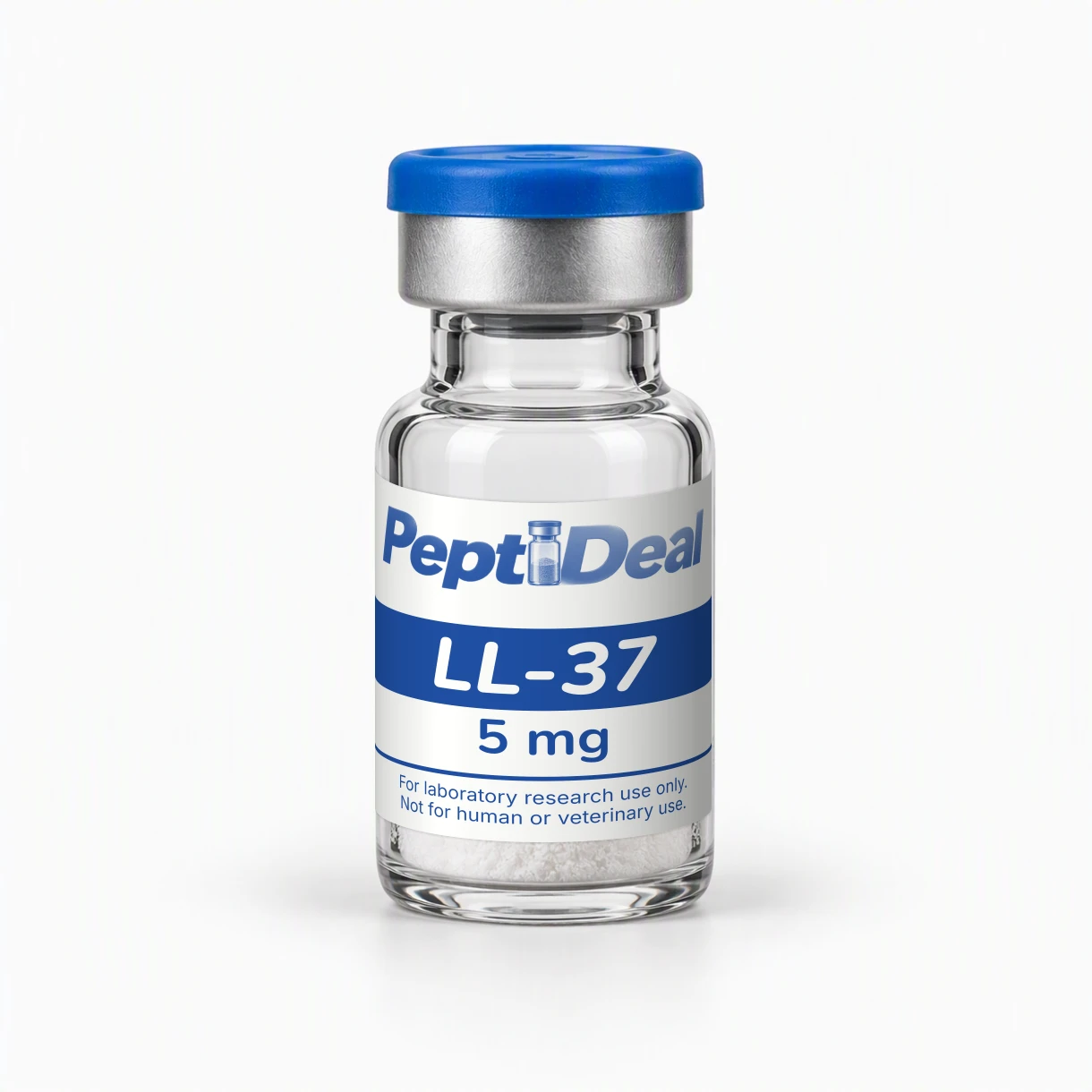
LL-37
Auch bekannt als: Cathelicidin LL-37
Jede Charge wird von unabhängigen Laboren auf Reinheit (≥ 99,8 %), Menge und Toxine geprüft.
Verfügbare Formate
Möchten Sie LL-37 bestellen?
Ab Dezember 2026 erhältlich.
Fragen Sie unsÜber LL-37
LL-37 ist ein Peptid aus 37 Aminosäuren und das einzige menschliche Mitglied der Cathelicidin-Familie antimikrobieller Peptide. Es wird aus seinem Vorläuferprotein hCAP18 freigesetzt und bildet eine amphipathische α-Helix.
Es wird in der Laborforschung zu antimikrobiellen Peptiden, Membranwechselwirkungen, Biofilmen und angeborener Immun-Signalübertragung in mikrobiologischen und Zellkulturmodellen untersucht.
Nur für Forschungszwecke.
Dieses Produkt ist ein Laborreagenz, ausschließlich für die In-vitro-Forschung.
Es ist kein Arzneimittel, Lebensmittel, Nahrungsergänzungsmittel oder Kosmetikum und nicht für die Anwendung beim Menschen oder in der Tiermedizin zugelassen.
Es darf Menschen oder Tieren nicht verabreicht werden.
Produktdaten
- CAS-Nummer
- 154947-66-7
- Formel
- C 205 H 340 N 60 O 53
- Molekulargewicht
- 4493,3 Gramm pro Mol
- Sequenz (37 AS)
- Leu-Leu-Gly-Asp-Phe-Phe-Arg-Lys-Ser-Lys-Glu-Lys-Ile-Gly-Lys-Glu-Phe-Lys-Arg-Ile-Val-Gln-Arg-Ile-Lys-Asp-Phe-Leu-Arg-Asn-Leu-Val-Pro-Arg-Thr-Glu-Ser
- Erscheinungsbild
- Weißes Pulver
- Lagerung
- Pulver: langfristig bei −20 °C lagern, vor Licht geschützt.
In Lösung: bei 2–8 °C lagern. - IUPAC-Name
IUPAC-Name
(4S)-5-[[(2S)-6-amino-1-[[(2S,3S)-1-[[2-[[(2S)-6-amino-1-[[(2S)-1-[[(2S)-1-[[(2S)-6-amino-1-[[(2S)-1-[[(2S,3S)-1-[[(2S)-1-[[(2S)-5-amino-1-[[(2S)-1-[[(2S,3S)-1-[[(2S)-6-amino-1-[[(2S)-1-[[(2S)-1-[[(2S)-1-[[(2S)-1-[[(2S)-4-amino-1-[[(2S)-1-[[(2S)-1-[(2S)-2-[[(2S)-5-carbamimidamido-1-[[(2S,3R)-1-[[(2S)-4-carboxy-1-[[(1S)-1-carboxy-2-hydroxyethyl]amino]-1-oxobutan-2-yl]amino]-3-hydroxy-1-oxobutan-2-yl]amino]-1-oxopentan-2-yl]carbamoyl]pyrrolidin-1-yl]-3-methyl-1-oxobutan-2-yl]amino]-4-methyl-1-oxopentan-2-yl]amino]-1,4-dioxobutan-2-yl]amino]-5-carbamimidamido-1-oxopentan-2-yl]amino]-4-methyl-1-oxopentan-2-yl]amino]-1-oxo-3-phenylpropan-2-yl]amino]-3-carboxy-1-oxopropan-2-yl]amino]-1-oxohexan-2-yl]amino]-3-methyl-1-oxopentan-2-yl]amino]-5-carbamimidamido-1-oxopentan-2-yl]amino]-1,5-dioxopentan-2-yl]amino]-3-methyl-1-oxobutan-2-yl]amino]-3-methyl-1-oxopentan-2-yl]amino]-5-carbamimidamido-1-oxopentan-2-yl]amino]-1-oxohexan-2-yl]amino]-1-oxo-3-phenylpropan-2-yl]amino]-4-carboxy-1-oxobutan-2-yl]amino]-1-oxohexan-2-yl]amino]-2-oxoethyl]amino]-3-methyl-1-oxopentan-2-yl]amino]-1-oxohexan-2-yl]amino]-4-[[(2S)-6-amino-2-[[(2S)-2-[[(2S)-6-amino-2-[[(2S)-2-[[(2S)-2-[[(2S)-2-[[(2S)-2-[[2-[[(2S)-2-[[(2S)-2-amino-4-methylpentanoyl]amino]-4-methylpentanoyl]amino]acetyl]amino]-3-carboxypropanoyl]amino]-3-phenylpropanoyl]amino]-3-phenylpropanoyl]amino]-5-carbamimidamidopentanoyl]amino]hexanoyl]amino]-3-hydroxypropanoyl]amino]hexanoyl]amino]-5-oxopentanoic acid